Marduk and Tiamat (“Enuma Elish”: The Babylonian Epic of Creation)

At first glance the story of Marduk and Tiamat in the “Enuma Elish” seems to be a creation story of Mesopotamia as told by the Babylonians. However, the subtext tells how humans mastered the volatile environment of Mesopotamia. Also, the myth grapples with understanding and accepting the cosmos as they understood it.

Layered below this creation myth is the rise of Babylon to become the principal power of the region. The “Enuma Elish” (Note 1) describes the lives of the succeeding generations of Gods, their conflicts with the Gods before Them, and ends with Marduk as their ruler. Each generation of Gods probably represents a prior group of peoples who lived the region. Since Marduk is the major God of the Babylonians, this myth then becomes the story of how Babylon came to rule Mesopotamia.

The myth starts by describing the ancient landscape of Mesopotamia, thousands of years ago. Apsu, the sweet water, mixes with Tiamat of the salt water. The symbol of their union is the mingling of the Tigris and Euphrates with the sea to produce the salt marshes. The sea was much farther inland then, and tides had more effect on the people living there. The landscape of the area is one of river bottoms, tidal marshes, swamps, and wetlands. Even the names of their first children, Lahamu (female) and Lahmu (male) which means “silt,” reflect this as well.

Into this watery beginning, Anshar (male) and Kishar (female) – the Gods of the Horizon and of the Rim of the Earth – are born. These two Gods are the parents of Anu, the Father of the Gods. Anu, the Ancestor of the Elder Gods, is the parent of Nudimmud, Marduk’s father. (Note 2). (Note 3).

The next generation of Gods were Enlil and Enki of the Sumerians. Unlike the first group, these Gods focused on developing agriculture and decreeing divine laws. While Anu ruled the Gods, Enlil granted kingship, and Enki created people. (In a similar story to Apsu and the noisy Gods is Enlil and the noisy humans. In both cases, the Gods tried to destroy the noisemakers, since the activities of farming disturbed them.)

In Tiamat’s case, the noisy ones were the next generation of Gods, who were replacing the original ones. They were draining the swamps, digging the canals, and irrigating the fields. These Gods were taming the “sweet water”, thereby killing Apsu as a God. The efforts of the new Gods threatened Tiamat, since They were transforming the salt marshes into farmland.

The “Emuma Elish” relates it as following: The noise was so great that Tiamat wanted those Gods gone. Apsu, Her Consort, tried to convince Her otherwise, but failed. When Enlil discovered Tiamat’s intent, He killed Apsu. Enlil’s reasoning was to allow the original waters of Apsu to become many forms of being such as canals.

Furious, Tiamat raises an army, which metaphorically reflects the violence of the times. Through continuous irrigation, salt made the land of the Sumerians infertile. Faced with dwindling resources including water, the various cities fought each other to gain these precious resources for their peoples. During this awful time, the suffering Sumerians wrote lamentations describing their misery — bodies melting in the sun and cities shrouded in smoke. Into this war-torn landscape came the Amorites, who adopted the Sumerian culture, and established their main city of Babylon. Under their king, Hammurabi, the Babylonians cemented their empire and imposed law and order in Mesopotamia.

This creation myth, the “Enuma Elish,” relates how the Babylonians came to power and recreated the world, making order out of chaos. Their principal God, Marduk, assumes power over the other Gods and defeats Tiamat. Unable to defeat Tiamat, the Sumerian Gods, Enki and Enlil cede their power to Marduk by granting “Enlil-ship” to Him. Meanwhile, the other Gods confer “Anu-power” on Him. Hence, several generations of Gods pass from importance. The “Enuma Elish” says, “We gave You (Marduk) Kingship, power over all and everything.”

After adopting the myths from the Sumerians, the Babylonians rewrote the creation myth to include the rise and rulership of Marduk. After Tiamat came Anu, who was the original head of the pantheon. With each succeeding generation, Anu shared his power first with Enlil and then with Enki. While They ceded their power to Marduk, Anu remained in the titular rule. In the “Enuma Elish,” the Babylonians acknowledge their predecessors, the Sumerians and the others. But they end the myth with Marduk recreating the world and establishing his reign. He does this by building the world on the bones of Tiamat, one of the Gods of the original peoples living there. Marduk remakes the world as the Babylonians remade Mesopotamia.

Note 1: The Mesopotamians have several creation myths. This is an analysis of one of them.
Note 2: An alternative interpretation has Ashar and Kishar be the children of Lahamu and Lahmu.
Note 3: The Sumerian myths have Ki, as the wife of Anu, help to create the heavens and the earth. Their children, Enlil and Ninlil create the world, and Enki sets the order of everything in the new world.

Works Used.
“Ancient Mesopotamian Gods and Goddesses.” U.K. Higher Education Project. 2011. Web. http://oracc.museum.upenn.edu/amgg/index.html .
Black, Jeremy and Anthony Green, “Gods, Demons and Symbols of Ancient Mesopotamia.” University of Texas: Austin. 1992.
Cicero, Sandra, “A Guide to the Babylonian Tarot.” Llewellyn: Woodbury, MN, 2006. Print.
King, L.W., “Babylonian Religion and Mythology.” Wisdom Library. 1903. Web. http://www.wisdomlib.org/mesopotamian/book/babylonian-religion-and-mythology/d/doc7086.html .
Dickie, Lloyd and Paul Boudreau, “Awakenings Higher Consciousness: Guidance from Ancient Egypt and Sumer.” Inner Traditions: Rochester (VT). 2015.
Jacobsen, Thorkild, “The Treasures of Darkness.” Yale University Press: New Haven. 1976.
Odin and Autosacrifice

About 10 years ago, I found myself reading Norse mythology and all the books considered part of the Heathen lexicon of lore. The whole reason I started reading books dealing with Norse mythology, history, and lore – I saw an unsettling picture of Odin on a website. The picture displayed him as an elder man with an eye-patch, but the look in his other eye came across like a leader offering a rebuke while simultaneously extending his hand.

The way that picture unsettled me actually prevented me from doing research into Heathenry for about six months. I was not sure I was ready to deal with another god after I had spent the majority of my life feeling betrayed by the Christian god; I certainly wasn’t sure I was ready to deal with a god that had the kind of unsettling presence I felt in that picture. I wrestled with the desire of wanting nothing to do with another god and wanting nothing more but to follow one. Internally, I waged a war against myself for half a year before I made a decision. I would brave the unknown.

I found the site that had housed the picture of Odin that I had originally seen, and I used the picture as a tool to imagine myself beside Odin in a place where we could safely talk. I didn’t struggle to figure out how to talk to him; I’d been raised in a tradition of spirit work. Actually, I tend to feel more comfortable and confident around spirits because of that – especially non-human spirits – than around people. Initiating conversation with Odin wasn’t difficult. The hard part for me was deciding to respond to the invitation he had offered through the way he had illuminated an image of himself that I happened to see.

Within the space of a few months of communicating and working with him, I learned a lot about both him and myself. I saw parts of me in him, like the willingness to break a promise to one person to ensure the safety and health of a community. I read forums where people openly railed against Odin for breaking oaths in the myths. He does break oaths in the stories, but the only time that happens is when the risk that would follow keeping the oath would prove higher than breaking it.

In all the stories I read, I started seeing Odin as a strategist and tactician, a war genius that was always several thousand steps ahead of everyone around him. I saw how he took in everything around him, even though he did not always voice it. I saw a god who was not afraid to experience new things, who knew when to be humble and when to be bold, and who treasured his friends and his community above the sanctity of everything else.

I also saw what others consider a darkness in him – the bloodlust, the thirst for war, the frenzy and ecstasy of magic at its finest. I have come to think of Odin’s thirst for war less as a desire to see people kill each other and more as a necessity in a grim battle against the cycle that eventually causes the destruction of the universe. I don’t think Odin cares about the causes of war that people invoke him for because the war he is waging against cosmic forces is of much more consequence. In some ways, he is the ultimate utilitarian strategist.

He is also a trickster. So much so, in fact, that people often forget that he is a trickster. People who shy away from Loki because of his trickster aspect often turn towards Odin, forgetting that Odin is just as much of a trickster as Loki is. Their trickster aspects seem to come from different places and serve different purposes, but there is a reason they are blood brothers. Odin’s trickster aspect seems to originate from his ability to disguise and deceive everyone around him; he almost always has an agenda to further his own cause. He weaves illusions and snares others in traps that they rarely see coming.

While Loki is also capable of shape-shifting and disguise, he also shatters illusions and uses the truth to confound people into doing what he wants. He sets up situations so that his enemies think that they have outsmarted and captured him; he turns the tides at the last moment and proves that his cunning is far superior. His strategy seems to rely on making plans on the spur of the moment; he is not a strategist that indulges in a lot of planning. He seems more like the type to trust his ability to get him out of tight spots, no matter the odds.

Together, the two of them are unstoppable. It is thus not surprising that the tale of Ragnarok shows them pitted against each other. Odin’s main goal is to keep the death of the universe at bay; his main aim seems to be to halt the progress of death. Loki’s main goal is to keep the cycle in motion; he is the embodiment of change. It thus makes sense that Odin and Loki would be incredible friends at the beginning of every cycle because everything is growing and expanding and changing in beautiful ways. At some point, though, a peak is reached and the universe begins to spiral more quickly towards decay. It is at that point the two of them must turn from the other because their goals clash horribly.

I learned this about Odin and Loki by reading the myths and the Eddas, and I learned by listening to them as they told me their stories in the astral realm. At some point, I learned enough to realize that I would be willing to commit myself to both of them in very different ways. I swore an oath to Odin, to be part of his army as a strategist and mage, an oath that keeps me bound to him as long as my soul continues to exist in any energetic form. I took this oath knowing exactly how deeply I was committing myself – I did not take it lightly.

Part of that oath, ten years ago, was that I would avoid the Christian god and Christianity to the best of my ability – a difficult thing to do in the middle of a Bible Belt. I threw out all of my old Bibles and Christian books. I stopped listening to Christian music, including Christian rock – a feat made more difficult by the fact that many alternative rock bands turn out to be Christian rock bands in disguise. I stopped letting friends drag me with them to church services. I did everything I could to rid my life of Christianity in all its guises.

Part of the reason I added that stipulation to the oath was that I knew how easy it would be for me to fall back into old patterns of letting friends/family take me to church with them, even though it made me miserable. I also knew how badly I yearned for a community, and the Christian church provides that for people. I did not want the temptation to be part of a community to tempt me away from one of the only gods who I had encountered who seemed to understand me at all. It was a stipulation, in other words, that I forced onto myself – it was not one that Odin required of me.

Still, for ten years, I avoided all things Christian. I refused to engage with the Golden Dawn system of ceremonial magic because it was rife with Christian symbolism. I couldn’t work with angels, even after encountering one, because of the stipulation I had placed on myself in the oath I took to Odin. I couldn’t really engage in relationships with people who weren’t atheist or polytheistic (and didn’t include the Christian god in their devotional practice). There was a lot I couldn’t do, which was fine for many years.

About three months ago, it started to really bother me that I couldn’t learn the systems of magic I was the most interested in because of that stipulation. It bothered me so much that I sat down one night and had a very long conversation with Odin about potentially renegotiating my original oath with him to have that stipulation removed. I purposefully approached him with a suggested alternative; I did not ask him to simply release me from that portion of the oath. After all, I had spent ten years offering him my refusal to engage with Christianity – I thus had to come prepared with something to offer in lieu of that.

So, I offered him blood. My own blood, to be exact. We discussed what that would entail, how often it would be, and we reached an agreement. Odin agreed to release me, and we renewed the oath with a new stipulation in place of the old one. The new oath was simply that I would continue to remain bound to his service as a strategist and mage, and I would offer him my blood once a month. In exchange for my oath, I gain access to a lot of places within the astral realm and can work with any/all spirits regardless of the religion that house them.

I try to do the autosacrifice on a Wednesday, since Wednesday is named for Odin. After I sterilize my hand with rubbing alcohol, I use a lancing device to prick my finger and place at least three drops (never more than nine) in a small offering dish that I then place on Odin’s altar. It’s a very small amount of blood, but blood magic is very, very potent. It is also incredibly important to ensure the environment is sterile before purposefully making yourself bleed.

While some may see using a lancing device as a “weak” method of offering blood, the reality is that blood carries a lot of potent magic regardless of the manner in which it is obtained. As long as Odin is satisfied with the offering (which he has been fine with so far), then I am less concerned about how other people view my methods. After all, it’s not like I’m making an offering to them. 

In any case, autosacrifice is not a path meant for everyone, and I have met few gods who would approach a devotee and ask for such an offering. Among those I know who do offer their own blood to their gods have done so after discussing it with their gods. It is never appropriate to assume that any/all gods will accept blood offerings. Some gods can and will find it offensive, especially if you offer it to them without discussing it first. As with any offering, it is imperative to talk to the gods first about an offering you are considering giving them rather than assume that something you haven’t given them before will automatically be accepted. Gods can/do reject offerings, which is why developing a strong relational practice with the gods is so important.


Time According to the Babylonians

In Mesopotamia, a region long settled by other peoples, the Babylonians had to establish their dominance. By adopting various myths from the Sumerians, and then amending them, they created a sense of the long view of time. Into this invention of time stretching into the infinite past, the Babylonians inserted themselves, thereby breaking the timeline into two parts: before and after their arrival. They grafted the legacy of the Sumerians to themselves. Moreover, possessing a concrete sense of time, the Babylonians then subdivided it in a number of ways, each division of time serving a religious or imperial need. They bifurcated time into two distinct parts – one: circular and repeating, the other: an arrow into the future. These two splits of time complemented each other in the Babylonian mind.

Every New Year which began at the Spring Equinox, the Creation Myth (Enuma Elish) was read. This myth begins with the original creation of the world by Tiamat, the God of Chaos, and Apsu, the God of Waters. Later Anu, a God from the succeeding generation becomes the “Father of the Gods.” Eventually, He cedes his powers to Enlil, from yet a newer generation of Gods, who seeks to overthrow the original Gods. After Apsu is killed, Tiamat wages war on the newer Gods. In desperation, Enlil goes to Marduk, the principal deity of Babylon, for help. On the condition that He is made the Ruler of the Gods, Marduk agrees. After killing Tiamat, Marduk remakes the world from her body.

This creation story cements Babylon’s place in Mesopotamian history. After ages of rule by other peoples and their Gods, Mesopotamia is then recreated by the Babylonians. Generations of Gods follow each other ending with Marduk. Thus, Babylon becomes the terminus point for the timeless past, and the future that is now Babylon. The ritual of reading the Creation Myth every New Year was the intersection of circle with arrow time, and also the combination of both.

In its various forms, the Gilgamesh Epic highlights the nexus of time and immortality. Within this epic is the story of a Great Deluge. Like the Creation Story, the time in the Great Flood is broken into two halves, the world before Babylon and after. According to this myth, the list of Kings before the Flood numbered ten. After the Flood, the Kings reigned from the City of Kish (in Sumer), with reigns consisting of 300 years to 1,200 years. In this story, comes a sense of a long past, a rupture, and then the start of a new age. Because Kish had great symbolic significance, the myth allows Babylon to become the heir to the ancient civilization of Sumer. The story gives to the people of Babylonia, the sense of a great destiny. Babylon is the New World remade from the older world. Once more, time in Babylonian perception was broken, and then welded together again.

The Gilgamesh Epic, itself, focuses on the questions of death and immortality. After his friend, Enkidu dies, Gilgamesh comes to dislike death. Resolving to end death for all, he searches for the key of immortality. During his adventures, various Gods tell him to enjoy life and accept death gracefully. Through a series of mishaps, Gilgamesh is denied immortality for himself and his people. However, he realizes that his city will exist long after his death. His immortality would come from his legacy, which is his city. Babylonians saw this in terms of themselves as the legacy of Sumer. Again it was presented as endless time that was disrupted.

In Babylon, the year was divided into two halves – summer and winter, in explicit circle time. In the myth of Ishtar’s (Inanna) Descent Into the Underworld, winter comes about when Ishtar sends her husband Tammuz (Dumuzi) to take her place in the Land of the Dead. In desperation, Tammuz then seeks help from his sister, Belit-seri (Geshtinanna). After much negotiation with the Gods of the Underworld, both siblings decide to take each other’s place for six months at a time.

Ishtar’s husband, Tammuz was the God of Crops and Flocks. The Babylonians saw Him as the life blood of the land and the sheep. When He went into the Underworld, winter came. At that time his sister, Belit-seri reemerged, and presided over the autumn harvest and wine making. She became the Goddess of Wine and Grapes.

At the Spring Equinox, the Babylonians started their New Year. To commemorate this, the King would enact a sacred marriage with the temple priestess of Ishtar. Their mating was to reaffirm the marriage of Ishtar, the Goddess of Fertility, with her husband, Tammuz. These marriage rites was to ensure that the King was accepted as one of the Gods, and blessed by Ishtar, who also blessed the crops. This was circle time, repeated every year at the same day.

In contrast, the Autumn Equinox was the beginning of the Royal Year. At this time, the King offered First Fruits for the blessings of the Gods for him and his city. Afterwards, he would begin a project such as building a temple. Counting regnal years in Babylon started with the harvest, and was often named for the King’s latest project. The passage of time was demarked by the reigns of kings and their deeds. Again the Babylonian sense of time was divided into two parts, one for the Gods and the other for the kings. Regnal time was inserted as an arrow to the future into the circle time of the harvests.

In their daily lives, the Babylonians were very conscious of the passage of time. They measured days, months, and years (with a nineteen month calendar to tract solar and lunar eclipses). They used artificial time to track governmental and commercial activity for regnal years and fiscal years. Against this backdrop of dividing time into smaller units came the sense of timelessness that rose from living in Mesopotamia. Being conscious of being a part of a succession of kingdoms in the region, the Babylonians both merged their myths with the Sumerians, and divided them into two parts, before Babylon, and after. Time for the Babylonians was to split into two parts, one an arrow pointing towards the future, whilst the other a circle that returned back to Babylon.

Works Used.

“Ancient Mesopotamian Gods and Goddesses.” U.K. Higher Education Project. 2011. Web. http://oracc.museum.upenn.edu/amgg/index.html .
Black, Jeremy and Anthony Green, “Gods, Demons and Symbols of Ancient Mesopotamia.” University of Texas: Austin. 1992.
Cicero, Sandra, “A Guide to the Babylonian Tarot.” Llewellyn: Woodbury, MN, 2006. Print.
King, L.W., “Babylonian Religion and Mythology.” Wisdom Library. 1903. Web. http://www.wisdomlib.org/mesopotamian/book/babylonian-religion-and-mythology/d/doc7086.html .
Cohen, Mark, “Festivals and Calendars of the Ancient Near East Calendar,” PDF. 2015.
Dickie, Lloyd and Paul Boudreau, “Awakenings Higher Consciousness: Guidance from Ancient Egypt and Sumer.” Inner Traditions: Rochester (VT). 2015.
Jacobsen, Thorkild, “The Treasures of Darkness.” Yale University Press: New Haven. 1976.

When the Gods Seem Distant

Sometimes, it becomes hard to hear the gods. Sometimes, it feels like the gods are no longer present. In reality, what has happened is that we have lost touch with our ability to communicate with the gods. We have stopped reaching out, stopped turning inward. In those moments, we have become too focused on the realities of our physical lives. 

Our lives are full of noise. In Western society, everyone is always busy. Being productive is a way of life – to the point that not doing something productive causes anxiety and induces shame. Because time is considered valuable, and not producing something is often viewed as wasteful. That means to tune-in to society we have to tune-in to the noise and we end up tapping into that need to produce more. To constantly create something, constantly be on the move. Just never slowing down. 

To hear the gods, though, we have to slow down. We have to breathe. We have to take the moments that come to us in-between the chaotic reality of our lives and just breathe. It is in those spaces that the gods are heard most clearly – is it any wonder that most people miss those moments? 

It’s very easy to tune-in to the stress caused by a busy schedule. I understand it myself – I’m a graduate student in my last semester of my Master’s program. In the next 6 weeks, I need to write somewhere between 50-70 pages to complete my thesis. In the next 8 weeks, I have to also write two 8-10 page book reviews for my African Politics class. In the next 14 weeks, I also have to write a 25-30 page paper on how development plans often fail in Africa for that same class. On top of that, I am the President of my school’s Pagan Student Association and the secretary for the Graduate History Student Association. I’m also a graduate teaching assistant who has to attend lectures, take attendance, and grade essay-based exams. On top of all of that, I have responsibilities as one of Loki’s priest, the founder of Loki’s Wyrdlings, and the Director of Loki University. I understand first-hand what it is like to be busy – my life might as well be the poster for what a fast-paced American life looks like. 

Some people will look at that list and say “wow, no way could I do that much.” I understand that – sometimes I don’t know how I do that much. And then I remember that I have ADHD and PTSD and that staying busy for me is literally a lifesaver. It keeps me from getting too caught up in the trauma of my past (research has shown that exposure therapy is actually incredibly damaging for people with PTSD though it is good for anxiety disorders and phobias). It also keeps me from getting bored. 

So how, in a life so busy, do I manage to find the time to speak with the gods? To communicate with them, to ensure that I don’t feel abandoned by them and that they are present? I make the time. I take the moments in-between the crazy pace of my life and I force them into a slower tempo. I listen as hard as I can, and I do the best I can to give the gods the same kind of attention I give to my friends when they are talking to me. Most importantly, I do the best I can to make consistent offerings to the gods. 

It is through offerings that the connections we have to the divine realm are maintained. It is through sacrifice that we enable the gods to communicate with us most clearly. Our offerings feed and nourish them – they are the subsistence the gods need. While we need physical food and drink to live physical lives, the gods need spiritual food. The gods are heavily present in my life because I make a point to make sure they are fed. I do the best I can to take the hints I am given. 

As an example, I attended a lecture from a guest speaker yesterday. He ended up discussing how he converted to Christianity near the end, which was a bit of a surprise twist considering the topic had nothing to do with Christianity. He talked about how he held no belief in healing, and then he found that the Christian god healed him of his addictions. He asked for healing and promised to tell the story in exchange for that healing – he has kept his end of the bargain, and his addictions have never returned. 

That story reminded me of the importance of sacrifice – of the exchanges we make with the gods. A lot of Christians will say that you should never make deals or bargains or try to broker with a god, but most Christians do not understand that the reason their deals/bargains tend to fail is because they do not keep their end of the bargain. They do not follow through with what they say they are going to do, so of course the god does not provide. That’s incredibly disrespectful. 

Sacrifice works on a very deep level – it is a reciprocal exchange. The gods provide me with a great deal, including the opportunity to experience them on a very personal level. In exchange, I provide them with offerings. Some of the things the gods give to me require larger sacrifices than others. That’s okay – I don’t mind giving the gods what they need. What I get from them, largely, is their presence. I love the gods, and I love having them around. 

Because of that, I do what I can to make sure that I take the moments I can find to take a breath and listen when they have something to tell me. I am not perfect at it – none of us are. But I do my best, and that’s all I can ask of myself. That’s all the gods ever ask of me, and it seems silly to require more of myself than the gods themselves ask. That doesn’t mean I don’t try to give more – sometimes I try to give so much that the gods tell me to take a break. I actually once had Loki tell me to stop obsessing over making sure I had given him an offering during the week – that happened when I was sick with a virus that made it hard to get out of the bed. I was determined to give him an offering, and Loki basically told me to stop being ridiculous and go back to bed. 

I have a hard time turning off the working mode that our society has indoctrinated into me – that carries over to my work with the gods to a greater extent than is necessarily healthy. At the end of the day, though, I enjoy having the gods around. Because I am secure in the knowledge the gods are always there, even when I don’t always hear them perfectly, I can stay secure in the relationships I hold with them. I am of the mind that they value their relationship with me the way I value my relationship with them. In that way, I don’t fall into the trap of feeling abandoned. Why would someone who cares for me the way I care for them abandon me? When the gods do seem distant, I remind myself that I am the one creating that distance and to reduce it, I have to tune out of the noise of the world. Once I do that, the distance disappears and the gods are as close as they have always been. 

Roman Polytheism and Spiritual Pollution

Mention “miasma,” “pollution,” or “purity” in regards to Polytheism, and many Pagans will take umbrage with these terms. Impurity is usually equated with sin and evil. Impurity carries a sense of a demonic quality. Therefore purity becomes a part of a cosmic struggle between good and evil. One reason is that Christianity has redefined these Polytheistic terms to match its theology. Since many Pagans are converts from Christianity, they will often think of these concepts in those terms. However, “miasma,” “pollution,” and “purity” have different meanings in Polytheism.

Paganism does have its version of “pollution” and “purity.” Pagans discuss “positive” and “negative” energies. People will cleanse themselves and their spaces routinely to clear out negative energy. For example, crystals are often cleansed before using them. Also, before rituals, many Pagans will smudge themselves to purify themselves and to clean out their ritual spaces.

Miasma and spiritual pollution are different from both negative energy and Christian sin. Negative energy powers destruction, sickness, and other such things. It can be removed by laughter or positive thinking. Sin is removed by baptism and confession. Miasma, which is specific to Greek Polytheism, is a “spiritual pollution that prevails over all, it is not an ‘evil thing.’” Continuing in his essay, Markos Gage says “Miasma is therefore something we incur in life, everyday life.” (Note 1) Public cleansing of communities is a regular part of the Hellenic and Roman calendars.

In Roman Polytheism, castus (the adjective) means being morally pure, pious, or ritually pure. Piety (pietas) is maintaining the right relations between people, their Gods, their families, and their communities. Castitas (the noun) is the purity of the ritual and the participants. (Note 2) That means everyone must be physically and mentally cleansed before conducting a ritual. Before a ritual, people perform ablutions by washing their hands and asking that the water purify them.

An error conducted in a ritual is a spiritual pollutant. It negates the ritual and risks the anger of the Gods. It is not that a God will smite someone, but is to maintain the Pax Deorum, the Peace of the Gods. Religious negligence leads to divine disharmony and the turning away of the Gods. This leads to the loss of protection for the family, community, and the individual.

The closest thing that Roman Polytheism has to Christian sin is nefas. This can be defined as anything which is contrary to divine law. Nefas is a failure to fulfill a religious duty. Nefas is a willful act of religious violation. In that case, the person is separated from the community.

Impurity can be thought of in terms to avoid contamination. This can include gossip, body fluids and disease. The most common is disease and corpse contamination. However, impurity is a state that can be remedied. A wide variety of purifications rituals were available, the simplest was bathing with water.

Polytheists regard the world to be neutral, which differs from Christian theology. St. Augustine stated that the world is both corrupt and corrupting. Therefore, humanity lives in a Fallen World. To Polytheists, the world is both clean and dirty. Kenaz Filan explains, “The world is a clean flowing stream, and miasma the sewage dumped into the water. We clean the stream by filtering that sewage or by redirecting it…to where it can be properly contained.” (Note 3)

Why focus on purity and pollution? When a person prays, divine, or perform any other sacred act, they are engaging with the Holy Powers. There is a doctrine in U.S. law called, “Clean Hands” (also called “Dirty Hands”). (Note 4) The plaintiff cannot have the judge participate in an illegal act. One example is a drug dealer cannot sue to have his stolen drugs be returned. Another is suing the hit man you hired to kill someone for failure to do their job. As Judge Judy says on her TV show, “the courts will not help anyone with dirty hands.” I believe that in our relations with the Gods, we can think of purity and pollution in those terms. By being “pure,” we continue to have the protection of the Gods.

Notes:
Note 1. Markos Gage, “Answers About Miasma,” from “With Clean Minds and Clean Hands,” Galina Krasskova, ed. P. 51. Markos Gage is a devotee of Dionysius and an artist.

Note 2. The Romans have a Goddess – Lua – who protects all things purified by rituals and for rituals.

Note 3. Kenez Filan, “Miasma” from “With Clean Minds and Clean Hands,” Galina Krasskova, ed. P. 69. Filan is the author of several books including “Drawing Down the Spirits (with Raven Kaldera)”. He is an initiated Houngan Si Pwen.

Note 4. Clean hands: “Under the clean hands doctrine, a person who has acted wrongly, either morally or legally – that is, who has ‘unclean hands’ – will not be helped by a court when complaining about the actions of someone else.” From The ‘Lectric Law Library, http://www.lectlaw.com/def/c202.htm

Works Used:
Thomas Kazen, “Purification” from “Ritual in the Ancient Mediterranean World.
Galina Krasskova, “With Clean Minds and Clean Hands”
Martin Lang, “On Purity — Private and Public (in Polytheism).” Academic paper.
L. Vitellius Triarius, “Religio Romana Handbook.”

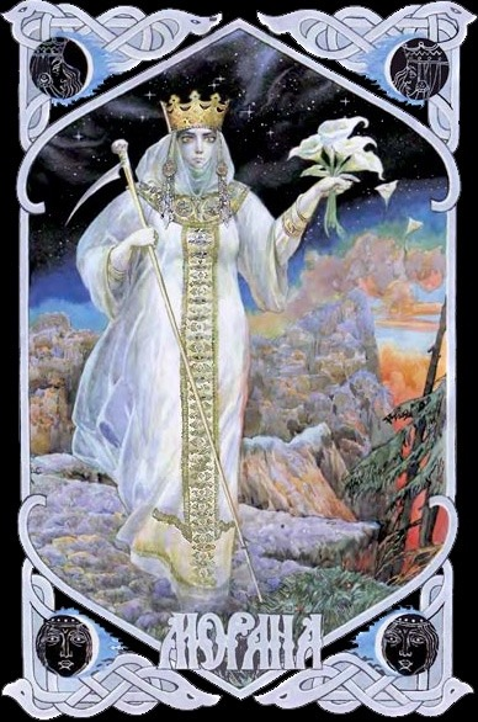
Morana and the Underworld

Artist: Unknown

As the winter months stretch on, many of us will continue to stare longingly at bare tree branches in the hopes that we will see green shoots sprouting. We look for this as a sign that the chill in the air is going to subside and that new life is coming. However, we should still take this time to appreciate the dead—not push it away. And, with that in mind, I wish to take you on a short journey to Nav, the Slavic world of the dead, and introduce you to Morana, goddess of winter and death.

 Morana is often seen carrying a scythe or sickle that she uses to cut the threads of life. In physical appearance, Morana, upon first glance, is terrifying; her skin is pale, she has long dark, stringy hair, her nails are long and sharp, and, sometimes, she’s even said to have fangs. However, this is not her only form, as Morana also is described as a young maiden. Yet, when she first appears to you, most often times you’ll get the ugly, old crone; it isn’t until you show an appreciation for her and a lack of fear for all she stands for that you will see the beautiful, maiden side to her.

Winter is considered to be the time of Morana. She brings the snow, hail, and cold winds with her. The thought of winter coming from Morana is mostly attributed to her relationship with Dazbog, the sun god. As it’s told, Morana seduces Dazbog, and pulls him down into her embrace. With Dazbog distracted, daylight lessens, and we are thrown into the darker, colder winter months. Unfortunately, in later parts to the myth, it is said that when Dazbog moved on from Morana, she poisoned him. As punishment for this, she was then banished to Nav.

Nav isn’t a dark or evil place, though. While it does contain its demons and dark parts, there is much good surrounding it as well. Remember Lada? The goddess of love (who also happens to be Morana’s mother) whom I’ve talked about in a prior post? She also resides in the underworld. And, while this might be shocking to hear, it’s important to know this for one key reason—new life comes from within; be it flowers coming up from the cold earth connected to the below underworld, or a new view on yourself through introspection. So, with that in the forefront of your mind, hopefully it eases some of the internalized fears you might have about the underworld. However, if you still wish for spring to just get here already, there is one more concept imbedded within these beliefs that I know you will appreciate—reincarnation. Reincarnation is something widely believed in in Slavic tradition. It’s thought that your soul could indeed return as anything from a descendant to even an animal. However, it’s still important to remember that, without death, there will be no rebirth.

Ascendant II: Theology for Modern Polytheists

The newest title from Bibliotheca Alexandrina is Ascendant II, edited by Michael Hardy. It contains essays from several different authors, including John Beckett, Wayne Keysor, John Michael Greer, Brandon Hensley, and myself.

My article “Applying Cross-Cultural Methods of Myth Interpretation to the Myth of Baldr’s Death” is featured about halfway through the book. For anyone curious about why Loki’s involvement in Baldr’s death is actually essential to the maintenance of the cosmological order, I highly suggest reading that essay.

I actually highly suggest buying a copy of Ascendant II (and its precursor, Ascendant I) because it features polytheists discussing theology in the modern world. Theology is not often something discussed in Pagan and Polytheist circles, despite all the work we do with and for the gods.

You can learn more about the contents of Ascendant II here and you can purchase your own copy of Amazon for $11 here. 

Frith

While frith directly translates to “peace,” it is a word that holds so much meaning inside it that “peace” does not do it justice. Frith and pax are not synonymous. Vilhelm Grønbech states in Culture of the Teutons,

A word such as the Latin pax suggests first and foremost…a laying down of arms, a state of equipoise due to the absence of disturbing elements; frith, on the other hand, indicates something armed, protection defense – or else a power for peace which keeps men amicably inclined (Grønbech 35).

Frith, then, is an actively defensive and protective type of peace. Frith, for the ancient Germanic people, formed the very foundation of the soul itself. Frith was such a vital part of life that it was considered a base necessity and not referred to as a virtue. Because of that, the society formulated around frith became one “based upon general unity, mutual self-sacrifice and self-denial, and the social spirit. A society, in which every individual, from birth to death, was bound by consideration for his neighbor” (Grønbech 13).

Frith was the power that made people friendly towards one other; it was the glue that bound society together. According to Grønbech, “Frith is the state of things which exists between friends. And it means, first and foremost, reciprocal inviolability” (Grønbech 18). That means everyone was expected to act from a place of frith; frith was more important than any disputes that arose.

Disputes could arise; arguments did occur. Frith did not prevent arguments. Instead, frith required that all arguments be held in such a way that people worked toward a settlement that satisfied the nature of frith. The active force of frith guaranteed a solution that resulted in communal peace. As Grønbech states,

Frith is something active, not merely leading kinsmen to spare each other, but forcing them to support one another’s cause, help and stand sponsor for one another, trust one another….the responsibility is absolute, because kinsmen are literally the doers of one another’s deeds (Grønbech 24).

Frith rested on the Germanic concept of unity. In the Western world, the way we are taught the idea of unity today is the same method that was used when Grønbech lived. Children are taught that a stick by itself is weak but a bundle of sticks together are strong – unity is thus conveyed as the addition of individuals to a collective.

The Germanic people did not understand unity in this way; for them, unity was the natural state of existence. Grønbech explains:

The Germanic attitude or mind starts from a different side altogether. Here, unity is not regarded as originating in addition; unity is first in existence. The thought of mutual support plays no leading part among these men; they do not see it in the light of one man after another coming with his strength and the whole then added together; but rather as if the force lay in that which unites them (Grønbech 33).

Frith is the uniting force; it is what creates the cohesive whole. It is because the Germanic people thought of unity in this way that frith became the most inviolable social reality. It is why the family clan was conceptualized as a fence, each member a stave set in the ground and enclosing a sacred ground.

That is where the Heathen concepts of innangard and utangard originate. Innangard is the inner circle; it is the family, the clan, the communities we build. It is where we owe our loyalties. Utangard is everything outside of those structures; it is everything external to our communities that threaten to destroy frith.

Frith is always accompanied by joy or glad-feeling. As Grønbech states,

Gladness or joy is not a pleasure derived from social intercourse, it draws its exhilarating strength from being identical with frith…Joy is a thing essential to humanity. It is inseparably attached to frith; a sum and an inheritance. But this joy, then, contained something in itself…What were the ideas attaching to this joy? The answer is contained in the old world honor (Grønbech 37-38).

Frith and joy are the foundation of honor, and it is the power of frith that makes communities cohesive and joyful.


Sources

Vilhelm Grønbech. Culture of the Teutons, Volume 1. Trans. W. Worster. London: Oxford University Press, 1931.


All Jackal’s Eve: A Moomas time myth for Kids (And the young at heart)

(Quick note: I didn’t create All Jackal’s Eve, it’s a fun tradition celebrated by some Kemetic families the day before Moomas. I was however inspired to write this as a contribution to the stories and celebrations!)

Every year on the night before Moomas Yinepu (Anubis) and Wepwawet celebrate the anniversary of the Celestial Cow by visiting Kemetic families all over the world. They hitch a golden sledge up to a team of living golden jackals and load it up with gifts and blessings for all those who did their best to live within Ma’at.

There are seven jackals, with one at the front and the rest side by side. Merry little oil lamps🪔 light Their way through the darkness as They sail across Nut’s starry body.

All the while our Akhu celebrate with feasting and parties, pointing the way towards our homes to the tireless golden jackals. If you see twinkling lights in the sky this night you just might be seeing the celebration as our ancestors smile down on us.

Children leave snacks out as offerings to the jackal gods and letters to be read. Yinepu and Wepwawet visit every home and leave presents under Moomas trees and in stockings. The trees represent the sacred evergreens imported into Egypt in ancient times and the bright lights strung on them represent our akhu shining as stars up above.

©Terra Akhert 2019

A-Lada Love: A look at Lada, Slavic Goddess of Beauty

Maximilian Presnyakov: “Lada” (“Slav cycle”), 1998.

It is an unfortunate fact that we have lost much of our Slavic practices. When I set out on my journey to learn more about my ancestors and their pagan practices, it was a hard hit to take to know so little is known about it all, especially their use of deities. Mikołaj Gliński put this sad fact best when he says:

Slavs surely had their deities. While many of them can reflect a more ancient shared Indo-European past, it remains disputable whether these gods were worshiped on the whole vast expanses of Slavic Europe (which ranged from the Baltic to the Black Sea) or rather varied depending on the locale and specific Slavic tribe.

However, the deeper you dig in, the more we seem to be uncovering (and recreating).

Thankfully, what we do know about the gods and folktales has given us the knowledge we needed to open up this door that lead to revitalizing the traditional Slavic religion. So, in order to introduce you to the basics, I want to start with a focus piece on the main goddess we focus on in today’s practices: Lada.

Lada is a stunning goddess who truly deserves more credit than she is given. She is not only a goddess of beauty, love, joy, and youth, but also a creation goddess and mother to all the gods. She provides a safe home to many and guards over marriage (many folk songs about marriage mention her in some capacity). 

Many times, if she has a message for you, she comes in the form of a lark. Her connection to all things jovial brings their beautiful song to you, to lift up your spirts when you’re feeling low. When this messenger of hers appears to you, she’s also asking you to look within yourself and go on a journey of self-discovery. Additionally, the lark’s mimicking of other songs and sounds also makes their appearance signal a message from the other realms; listen to how they sound. What are they mimicking…what else is Lada trying to tell you?

Some also connect her with plants with two of the biggest being cherries and peonies. Cherries are considered to be a plant of immortality and combine nicely with Lada’s goddess of beauty and youth aspect. Peonies are for prosperity and good luck, linking it to her side of joy.

The time of the year associated with Lada is spring and summer. Spring brings that rebirth that helps one look within themselves and transform into something greater. Something that I also associate Lada with is the Summer Solstice and Slavic Valentine’s day, which is the day after Solstice. The Slavic Valentine’s day connects to Lada’s love goddess aspect. There is dancing and singing around a fire. One ritual that takes place around this fire is leaping across (carefully!). This is meant to ensure purification and protect against bad energy as well as radiate healing powers. 

If you would like to leave an offering to Lada, she is particularly fond of receiving honey (a symbol of fertility and prosperity) and also responds well to songs sung or played in her honor.

Sources:

Gliński, Mikołaj. “What Is Known About Slavic Mythology.” Culture.pl, 29 Mar. 2016, culture.pl/en/article/what-is-known-about-slavic-mythology.

Warnke, Agnieszka. “9 Slavic Rituals & Customs of Ye Olden Days.” Culture.pl , 9 Nov. 2015, culture.pl/en/article/9-slavic-rituals-customs-of-ye-olden-days.