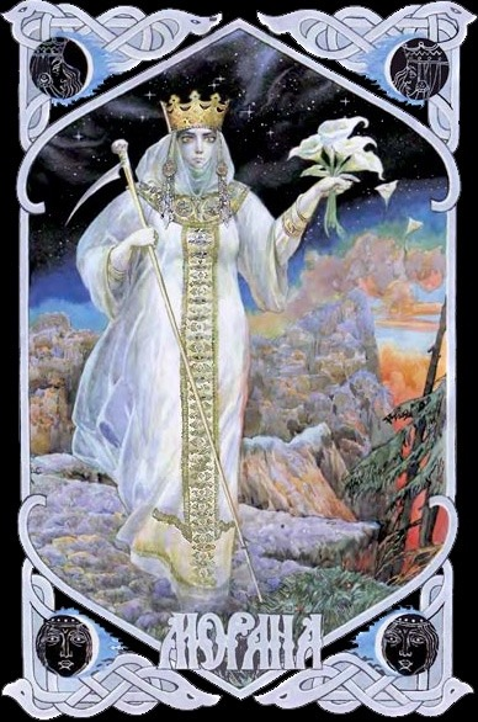
Morana and the Underworld

Artist: Unknown

As the winter months stretch on, many of us will continue to stare longingly at bare tree branches in the hopes that we will see green shoots sprouting. We look for this as a sign that the chill in the air is going to subside and that new life is coming. However, we should still take this time to appreciate the dead—not push it away. And, with that in mind, I wish to take you on a short journey to Nav, the Slavic world of the dead, and introduce you to Morana, goddess of winter and death.

 Morana is often seen carrying a scythe or sickle that she uses to cut the threads of life. In physical appearance, Morana, upon first glance, is terrifying; her skin is pale, she has long dark, stringy hair, her nails are long and sharp, and, sometimes, she’s even said to have fangs. However, this is not her only form, as Morana also is described as a young maiden. Yet, when she first appears to you, most often times you’ll get the ugly, old crone; it isn’t until you show an appreciation for her and a lack of fear for all she stands for that you will see the beautiful, maiden side to her.

Winter is considered to be the time of Morana. She brings the snow, hail, and cold winds with her. The thought of winter coming from Morana is mostly attributed to her relationship with Dazbog, the sun god. As it’s told, Morana seduces Dazbog, and pulls him down into her embrace. With Dazbog distracted, daylight lessens, and we are thrown into the darker, colder winter months. Unfortunately, in later parts to the myth, it is said that when Dazbog moved on from Morana, she poisoned him. As punishment for this, she was then banished to Nav.

Nav isn’t a dark or evil place, though. While it does contain its demons and dark parts, there is much good surrounding it as well. Remember Lada? The goddess of love (who also happens to be Morana’s mother) whom I’ve talked about in a prior post? She also resides in the underworld. And, while this might be shocking to hear, it’s important to know this for one key reason—new life comes from within; be it flowers coming up from the cold earth connected to the below underworld, or a new view on yourself through introspection. So, with that in the forefront of your mind, hopefully it eases some of the internalized fears you might have about the underworld. However, if you still wish for spring to just get here already, there is one more concept imbedded within these beliefs that I know you will appreciate—reincarnation. Reincarnation is something widely believed in in Slavic tradition. It’s thought that your soul could indeed return as anything from a descendant to even an animal. However, it’s still important to remember that, without death, there will be no rebirth.

Shadow Patrons (Gods)

In Polytheism, people have a variety of relationships with various Gods. Some have a Patron (Matron), who forms a favorable relationship with them. (Not every Polytheist has a Patron, since each God chooses their level of connection with humans.) A “Shadow Patron” (Note 1) is a God who chooses to have an adversarial relationship with a human.

Why would a God have an antagonistic affiliation with someone? It depends on the Polytheism and the particular Gods. Some people believe that the Shadow Patron works with a person to burn off the bad luck in the Ancestral line. Some Gods want to test the fitness of the person, before They ask any service of that human. For some Gods, that is their nature, such as Nergal of Babylon, who states, “I just break things.”

In my perspective, a Shadow Patron forces you to handle the psychic energy of the hurt or grief. You are forced to cope with your wounds in order to do what They require of you. Since this energy is a form of impurity, it needs to be cleansed. You need to be spiritually ready to do the various sacred acts asked of you by the Gods.

Apollo is my “Shadow Patron.” For me, it is because I do two things that this God is particular about – divination and prayers. In Roman Polytheism, both sacred activities are associated with Apollo, He is particular about doing these religious rituals correctly. Moreover, He wants ensure that I am worthy to do each. Through testing my mettle, Apollo guarantees both to his satisfaction.

Since this God is well-known to force Himself on unwilling females, I actively disliked Him. When I was a teenager, I was the victim of unwanted male attention. Hence, I avoided Apollo like the plague (which is ironic since in Roman Polytheism, He adverts the plague). When I began writing rituals and prayers, Apollo came and refused to leave. Then I started practicing Roman-style divination. At that point, Apollo instructed me on how He wanted these acts conducted. A hard taskmaster, He drove me to hone my craft for both.

As I worked through this difficult relationship, I came to realize that Apollo is my Shadow Patron. Because He wants what I do and say to be the Truth. Apollo takes me places that I refuse to go. He does not allow me to “spiritually bypass.” (Note 2). That means I have to do deep sacrifices for Him, which usually involve things that my injured brain balks at. (Note 3)

It seems ironic that the God of the Sun and of Logic would have me focus on the unconscious realm. I can explain this. Since rituals between the Gods and the community entail a liminal space, preparation needs to be made. In a ritual, the full emotional spectrum of the community is melded into one. That includes the unconscious shadows of each person. All of this needs to be harmonized before the Gods can be contacted.

Furthermore, Apollo rules the Day, which is consciousness. By doing so, He has defined the Night, which is unconsciousness. Standing in the blinding Light, one can see the deepest Night. Why is this important? In divination and in prayer, the force of the hurt, the grief, and resentment is released. This turns Day into Night. The Dark and the Light must be in balance for the Dark holds the Light as the Light holds the Dark. This seeming binary of Dark/Light is not Bad/Good, but a nonduality (Note 4) with shades of Grey between the Two.

In the “Inheritors: Moving Forward from Generational Trauma,” Gita Baack writes that “resilience is the process of creating meaning out of the contradictions of life’s darkness and light. It builds on the strength of relationships and community.” (Note 5) That is for me, a major reason for Apollo being my Shadow Patron.

Divination and prayers are sacred acts. To perform each, the human communicates directly with the Holy Powers. The Pax Deorum (The Peace of the Gods) has to be maintained between the people and the Gods. This is one reason for Shadow Patrons.

Notes:
Note 1. Shadows are considered to be the archetypes of the darker aspects of life such as the Underworld. A Shadow God could be a God who is of the Underworld or of War.
Note 2. “Spiritual bypassing is a mistaken belief that if we pray enough…eat right, and only think positive thoughts, our life will ascend finally reaching enlightenment.” Linda Star Wolf, “Soul Whispering,” Page 154.
Note 3. I have a traumatic brain injury.
Note 4. “Nonduality” means “non-separation and fundamental wholeness.” It comes from Eastern Religious thought.
Note 5. Gita Baack, “Inheritors: Moving Forward from Generational Trauma,” P 149.

Works Used:
Gita Baack, “Inheritors: Moving Forward from Generational Trauma.”
Raven Kaldera, “Dealing with Deities.”
Galina Krasskova, “With Clean Minds and Clean Hands.”
Linda Star Wolf, “Soul Whispering.”

Ascendant II: Theology for Modern Polytheists

The newest title from Bibliotheca Alexandrina is Ascendant II, edited by Michael Hardy. It contains essays from several different authors, including John Beckett, Wayne Keysor, John Michael Greer, Brandon Hensley, and myself.

My article “Applying Cross-Cultural Methods of Myth Interpretation to the Myth of Baldr’s Death” is featured about halfway through the book. For anyone curious about why Loki’s involvement in Baldr’s death is actually essential to the maintenance of the cosmological order, I highly suggest reading that essay.

I actually highly suggest buying a copy of Ascendant II (and its precursor, Ascendant I) because it features polytheists discussing theology in the modern world. Theology is not often something discussed in Pagan and Polytheist circles, despite all the work we do with and for the gods.

You can learn more about the contents of Ascendant II here and you can purchase your own copy of Amazon for $11 here. 

Frith

While frith directly translates to “peace,” it is a word that holds so much meaning inside it that “peace” does not do it justice. Frith and pax are not synonymous. Vilhelm Grønbech states in Culture of the Teutons,

A word such as the Latin pax suggests first and foremost…a laying down of arms, a state of equipoise due to the absence of disturbing elements; frith, on the other hand, indicates something armed, protection defense – or else a power for peace which keeps men amicably inclined (Grønbech 35).

Frith, then, is an actively defensive and protective type of peace. Frith, for the ancient Germanic people, formed the very foundation of the soul itself. Frith was such a vital part of life that it was considered a base necessity and not referred to as a virtue. Because of that, the society formulated around frith became one “based upon general unity, mutual self-sacrifice and self-denial, and the social spirit. A society, in which every individual, from birth to death, was bound by consideration for his neighbor” (Grønbech 13).

Frith was the power that made people friendly towards one other; it was the glue that bound society together. According to Grønbech, “Frith is the state of things which exists between friends. And it means, first and foremost, reciprocal inviolability” (Grønbech 18). That means everyone was expected to act from a place of frith; frith was more important than any disputes that arose.

Disputes could arise; arguments did occur. Frith did not prevent arguments. Instead, frith required that all arguments be held in such a way that people worked toward a settlement that satisfied the nature of frith. The active force of frith guaranteed a solution that resulted in communal peace. As Grønbech states,

Frith is something active, not merely leading kinsmen to spare each other, but forcing them to support one another’s cause, help and stand sponsor for one another, trust one another….the responsibility is absolute, because kinsmen are literally the doers of one another’s deeds (Grønbech 24).

Frith rested on the Germanic concept of unity. In the Western world, the way we are taught the idea of unity today is the same method that was used when Grønbech lived. Children are taught that a stick by itself is weak but a bundle of sticks together are strong – unity is thus conveyed as the addition of individuals to a collective.

The Germanic people did not understand unity in this way; for them, unity was the natural state of existence. Grønbech explains:

The Germanic attitude or mind starts from a different side altogether. Here, unity is not regarded as originating in addition; unity is first in existence. The thought of mutual support plays no leading part among these men; they do not see it in the light of one man after another coming with his strength and the whole then added together; but rather as if the force lay in that which unites them (Grønbech 33).

Frith is the uniting force; it is what creates the cohesive whole. It is because the Germanic people thought of unity in this way that frith became the most inviolable social reality. It is why the family clan was conceptualized as a fence, each member a stave set in the ground and enclosing a sacred ground.

That is where the Heathen concepts of innangard and utangard originate. Innangard is the inner circle; it is the family, the clan, the communities we build. It is where we owe our loyalties. Utangard is everything outside of those structures; it is everything external to our communities that threaten to destroy frith.

Frith is always accompanied by joy or glad-feeling. As Grønbech states,

Gladness or joy is not a pleasure derived from social intercourse, it draws its exhilarating strength from being identical with frith…Joy is a thing essential to humanity. It is inseparably attached to frith; a sum and an inheritance. But this joy, then, contained something in itself…What were the ideas attaching to this joy? The answer is contained in the old world honor (Grønbech 37-38).

Frith and joy are the foundation of honor, and it is the power of frith that makes communities cohesive and joyful.


Sources

Vilhelm Grønbech. Culture of the Teutons, Volume 1. Trans. W. Worster. London: Oxford University Press, 1931.


All Jackal’s Eve: A Moomas time myth for Kids (And the young at heart)

(Quick note: I didn’t create All Jackal’s Eve, it’s a fun tradition celebrated by some Kemetic families the day before Moomas. I was however inspired to write this as a contribution to the stories and celebrations!)

Every year on the night before Moomas Yinepu (Anubis) and Wepwawet celebrate the anniversary of the Celestial Cow by visiting Kemetic families all over the world. They hitch a golden sledge up to a team of living golden jackals and load it up with gifts and blessings for all those who did their best to live within Ma’at.

There are seven jackals, with one at the front and the rest side by side. Merry little oil lamps🪔 light Their way through the darkness as They sail across Nut’s starry body.

All the while our Akhu celebrate with feasting and parties, pointing the way towards our homes to the tireless golden jackals. If you see twinkling lights in the sky this night you just might be seeing the celebration as our ancestors smile down on us.

Children leave snacks out as offerings to the jackal gods and letters to be read. Yinepu and Wepwawet visit every home and leave presents under Moomas trees and in stockings. The trees represent the sacred evergreens imported into Egypt in ancient times and the bright lights strung on them represent our akhu shining as stars up above.

©Terra Akhert 2019

Gods and Spirits of the Land and Waters

December is the time when Roman polytheists honor the rivers and the hills.

My first experience with a God was with the River God of the Kennebec River in Maine. When I met the Kennebec, She was wild and untamed in spite of being dammed for over a hundred years. (Note 1) (Note 2). My family lived at the meeting of this river with the Dead River at The Forks. Although the Dead River is considered a branch of the Kennebec, it has a different nature. According to my late grandfather (former Maine Guide), this river was called “Dead” since it took so many lives of people trying to travel the river. While the Dead was quiet and menacing. I could sense that the Kennebec did not tolerate humans very much either.

Since then, I have met the acquaintances of other River Gods. The ancient God of the Potomac of Washington D.C. is so primordial that He is beyond language. The New River of West Virginia, although more primeval, is amused by humans and their activities.

One place that I have had direct experiences of land spirits is Western Maryland. This mountainous region has vast forests, meandering creeks, and wild rivers. It was first traversed by various Native American nations who warred with each other. Later the combatants of the French and Indian War and U.S. Civil War left their imprint with battles. Besides this bloody history, phantom beasts, unquiet ghosts, and odd people inhabited the area. (The most famous beasts are the Dwayyo, a werewolf-like creature and the Snallygster, a reptilian-avian creature.) The nexus of all this weirdness is South Mountain, which is an extension of the Blue Ridge Mountains.

The strangeness of Western Maryland includes experiencing displacement of time and space. Returning home from Chambersburg (PA), I went through an unknown portal. I found myself navigating my car through a herd of mastodons, which were browsing on spruce trees. Dodging the hairy beasts, I kept going until I went through another portal back to my own time. I later found out that my experience was not that unusual for this area.

Echoing my experiences, Regis Boyer wrote in his forward of “Demons and Spirits of the Land,” by Claude Lecouteux. (Note 3), “We evolve within an inhabited ‘natural’ world, one in which the gods themselves, or the deified dead, are the cornerstone of reality. As a result it is a world that cannot conform to appearances.” (Note 4) Boyer further observed that the “Spirits of the Land” (Genii Loci) have been devalued, starting with Christianity. Even in modern times, the devaluing continues, but the Sacred still manifests Itself.

In examining ancient and medieval customs, Claude Lecouteux concluded that people once understood that they cohabited with the Spirits (Gods). Because of this, ancient peoples performed rituals, listened to oracles and made sacrifices. The folk customs of the medieval peoples such as the “rite of crossing a river” continued to fulfill this contract with the Spirits (and various Gods). Lecouteux continued, “they left us one essential law: mankind should live in harmony with the surrounding nature…. In order to prosper then, we must continue to honor the genii loci.” (Note 5).

Lecouteux interprets the ancients as asserting that the world is neither human nor spirit centered, but is full of spirits. Some are Gods, some are land or water spirits, but none are human. A wise person understands that they would have to co-exist with all of these Spirits, since they will encounter Them at times.

Recognizing the power of the Gods, Christianity sought to tame Them. The Church renamed various Gods as Saints, and built churches by sacred fountains and in groves. Those Spirits (and Gods) they could not tame, the Church called demons, who had been expelled from heaven. Meanwhile, lay people often saw these Spirits as dragons, fairies, or simply “The Little People.” No matter how much the Church (and later Science) sought to de-sanctify Them, the Gods still remained powerful.

The Gods of Water have many sacred places throughout Europe, which are still recognized. The Severn of the U.K. is named for an old British Goddess. The Rivers Boyne and Shannon in Ireland are named for the Gods Boann and Sinann respectively. The healing springs at Bath, England is the sacred place of Sulis, the Celtic Goddess of Healing. The Romans revered the Tiber River as Tiberinus. Each of these Gods received offerings from local peoples.

I, as a Roman Polytheist, do not see rivers, springs, mountains, and forests as aspects of “nature.” For me, They are not part of one divine entity such as “Mother Earth.” Each has their own power. Some heal, some kill, but all need to be respected. Bodies of water have yielded offerings of silver made by people, who understood the power of these Spirits. One does not enter a forest without permission nor drink from a spring. The Land and Water Spirits remain vigilant, ready to assert Themselves even in modern times.

Tourists like to white-water raft on the Kennebec and Dead Rivers. However, these rivers will claim lives as their due. The loggers who once drove logs down the rivers to the mills understood this. They knew these rivers took what was rightfully theirs.

Notes:
Note 1. Gods and Spirits of the Land and Waters include Those of cities, forests, mountains, and streams.
Note 2. The dam was removed in 1997. Since then, She has reasserted Herself as a powerful, wild river.
Note 3. Lecouteux, Claude, “Demons and Spirits of the Land,” translated by Jon Graham. Inner Traditions: Rochester (VT). 2015. Lecouteux, who is French, specializes in the study of medieval folklore and magic. He taught at the Paris-Sorbonne University.
Note 4. Page x, Claude Lecouteux
Note 5. Page 182, Claude Lecouteux

Works Used:
Fair, Susan, “Mysteries and Lore of Western Maryland.” History Press: London. 2013.
Lecouteux, Claude, “Demons and Spirits of the Land,” translated by Jon Graham. Inner Traditions: Rochester (VT). 2015.
Rada, James, Jr., “Looking Back: True Stories of Mountain Maryland.” Legacy Publishing: Gettysburg (PA). 2017.
A-Lada Love: A look at Lada, Slavic Goddess of Beauty

Maximilian Presnyakov: “Lada” (“Slav cycle”), 1998.

It is an unfortunate fact that we have lost much of our Slavic practices. When I set out on my journey to learn more about my ancestors and their pagan practices, it was a hard hit to take to know so little is known about it all, especially their use of deities. Mikołaj Gliński put this sad fact best when he says:

Slavs surely had their deities. While many of them can reflect a more ancient shared Indo-European past, it remains disputable whether these gods were worshiped on the whole vast expanses of Slavic Europe (which ranged from the Baltic to the Black Sea) or rather varied depending on the locale and specific Slavic tribe.

However, the deeper you dig in, the more we seem to be uncovering (and recreating).

Thankfully, what we do know about the gods and folktales has given us the knowledge we needed to open up this door that lead to revitalizing the traditional Slavic religion. So, in order to introduce you to the basics, I want to start with a focus piece on the main goddess we focus on in today’s practices: Lada.

Lada is a stunning goddess who truly deserves more credit than she is given. She is not only a goddess of beauty, love, joy, and youth, but also a creation goddess and mother to all the gods. She provides a safe home to many and guards over marriage (many folk songs about marriage mention her in some capacity). 

Many times, if she has a message for you, she comes in the form of a lark. Her connection to all things jovial brings their beautiful song to you, to lift up your spirts when you’re feeling low. When this messenger of hers appears to you, she’s also asking you to look within yourself and go on a journey of self-discovery. Additionally, the lark’s mimicking of other songs and sounds also makes their appearance signal a message from the other realms; listen to how they sound. What are they mimicking…what else is Lada trying to tell you?

Some also connect her with plants with two of the biggest being cherries and peonies. Cherries are considered to be a plant of immortality and combine nicely with Lada’s goddess of beauty and youth aspect. Peonies are for prosperity and good luck, linking it to her side of joy.

The time of the year associated with Lada is spring and summer. Spring brings that rebirth that helps one look within themselves and transform into something greater. Something that I also associate Lada with is the Summer Solstice and Slavic Valentine’s day, which is the day after Solstice. The Slavic Valentine’s day connects to Lada’s love goddess aspect. There is dancing and singing around a fire. One ritual that takes place around this fire is leaping across (carefully!). This is meant to ensure purification and protect against bad energy as well as radiate healing powers. 

If you would like to leave an offering to Lada, she is particularly fond of receiving honey (a symbol of fertility and prosperity) and also responds well to songs sung or played in her honor.

Sources:

Gliński, Mikołaj. “What Is Known About Slavic Mythology.” Culture.pl, 29 Mar. 2016, culture.pl/en/article/what-is-known-about-slavic-mythology.

Warnke, Agnieszka. “9 Slavic Rituals & Customs of Ye Olden Days.” Culture.pl , 9 Nov. 2015, culture.pl/en/article/9-slavic-rituals-customs-of-ye-olden-days.

Druidry, and The Hag of the Ironwood

Image by Hellanim

At their roots, druids are magicians (or shamans) who connected to the Earth and can call upon its’ magic in order to counsel, heal, teach, and divinate. In Druidic practice, there are many gods and goddesses that stand out:  Cernunnos, Brigid, Manannan mac Lir, Rhiannon, Lugh…Celtic deities. However, in today’s pagan society, we have created a melting pot of beliefs; blending the old gods and goddesses into even older practices to create something new and beautiful.

This open-mindedness to blending traditions has opened up many doors within modern paganism. If it’s one thing that can be said for certain, it is that our creativity cannot be stifled. So, with this thought in mind, I wish to open you up to a non-traditional goddess that I turn to in my work as a druid: Angrboða—The Hag of the Ironwood, Mother of Monsters.

Not many people will recognize that name and, those that do, would probably struggle to call her a goddess. At her core, Angrboða is a giantess with a name that means ‘announcer of sorrow’. What can also be off-putting to some is her ‘Mother of Monsters’ title, as she is mother to Loki’s three monsterous children; Hel, Fenrir, and Jörmungandr.

But what makes her perfect for druid work is, underneath this harsh exterior, she has an impassioned connection to nature and is a powerful wolf shapeshifter that can teach even the most seasoned shaman a thing or two about transforming themselves. Plus, she is a shaman herself, with an extensive knowledge of magic and divination. And, even though her children are deemed monsters, her maternal instincts rival that of any mother goddess.

Now, as her other (main) title entails, she hails from the Ironwood—a powerful realm known for the giantesses who protect it and the wolves within. While all of them are known to be connected to nature (namely the trees), Angrboða is a leader among them, a high priestess, if you will. And she is always willing to share what she knows with those she deems worthy (especially the lost, the lonely, and those in need of a mother).

However, be prepared to WORK. Angrboða does not take kindly to slacking. She only works with those who are willing to put the time and effort into developing their craft above and beyond what they ever fathomed possible for them. But, once you’ve proven yourself, she will envelop you in a loving and motherly embrace and protect you with the ferocity of her wolf side. As with any deity, showing your devotion through offerings also helps. Some offerings she truly appreciates are raw meat, to appease the wolf, and anything from nature (bones, leaves, sticks, stream water, etc.).

Angrboða truly embodies what it means to be a druid; someone who calls upon the Earth for knowledge and is willing to help those who are desperate for help and healing. So, I hope you will open your hearts to someone new, someone outside the traditional realm of Druidry.  

Hekate, Anubis, and My Brain Injury

My perception of the Gods is that They exist in the Eternal Now. It is the nexus of all time – past, present, and future. It is also the state of “everything is everywhere and always” and “every point of space touches every point of time.” (Note 1) We as humans create in our consciousness, the past, present and future. When the Gods reach out to people, it is not necessarily according to our perception of time. My experience of Anubis and Hekate, two Gods of the Dead, happened that way.

I met Hekate and Anubis together, three months before my life-changing accident. I regard being crushed nearly to death by a faultily constructed wall to be a random event. I do not subscribe to the belief that everything happens for a reason. I see the Universe to be random. I believe that the Gods, Spirits, and everyone else works out each occurrence for Themselves. In my case, Hekate and Anubis decided to use my accident for Their purposes.

At a Pagan gathering many years ago, I attended a Norse seidr (ritual of speaking to the Dead) to ask about my deceased father. As with all religious activities, I prepared by washing and dressing in my formal Roman stola and palla. The seidhr was held at a campground, in the evening. The seidhrwoman sat high on a picnic table, with everyone sitting on either side on benches. Because I came later, I had to sit on the lone chair in between the benches. Covering my head with my palla, I was ready for the ritual. Apparently at the seidhr, I resembled the Goddess Hecate.

After the seidr began, I felt myself going away. The last thing that I heard was someone faintly asking about Anubis. At the time, I did not expect to be possessed by a Deity. Usually when people are to be possessed by a God, they plan for it and assemble a crew to help them. I was an “accidental” possession, totally unexpected by anyone.

I have no memory of what happened after we approached the Underworld during the ritual. I was told by witnesses that Hecate took over my body. The seidhrwoman later told me that she had received a vision of Hecate coming to the seidhr dressed as a Roman.

After Hecate left my body, I was totally out of it. I felt like I had been struck by lightning, dragged for miles behind a fleet of Mack trucks, and run over repeatedly. Dazed and confused, I panicked. Fortunately for me, the seidhrwoman knew what to do to help me. First, she had me drink water and eat some crackers. Then, she spritzed me with lavender. All the while, she discussed the weather with me. Eventually, I came back to my body.

Disoriented, I asked the seidrwoman what had happened. First, she had a prior vision of Hekate attending the seidr. When I came in, I was Hekate come to life. During the seidr, Hekate used my body to talk to the people attending about their Dead.

Later together with the seidrwoman and the woman who had asked about Anubis, we had a private seidr. While answering the other woman’s question, the seidrwoman suddenly transformed into Anubis. After taking command of her body, He commandeered a golf cart. After ordering us in, Anubis took us on a wild ride through the camp. Riding in a golf with a God driving it will unsettle anyone. That is how I met Anubis, the Egyptian God of the Dead.

My experiences that weekend were too weird, even for me. They were things to file away under “interesting stories.” Then my freak accident happened, and almost killed me. At that time, Hekate and Anubis reintroduced Themselves to me.

During my coma and later my brain “fugues,” Hekate and Anubis roamed with me throughout the Lands of the Dead. Not alive, but not dead either, I floated between the worlds like a specter. Wandering about, I met Stellar’s Sea Cow, an extinct mammal, who guided me back to life. Along with Her, was Dire Wolf, a prehistorical mammal, who showed me his worlds of wonder, and Diplocaulus, the boomerang-headed amphibian of the early Permian, who taught me play again. With their help, I came back to the Land of the Living. Still hovering at the threshold, I was hesitant to return. Anubis whispered to me that He was the Key, The Opener of the Way. Before I could react to that, I was propelled through the threshold.

My work for these two Gods is now to help the newly Dead to find the map to their Land of the Dead. (Maps are needed for the Dead to follow or They get lost, wandering hopelessly about.) When I go into a fugue state, I meet the Dead then. Also, I formed a cultus to honor extinct and prehistoric animals. (Note 2)

As I have said, I do not believe that either Hekate or Anubis caused my accident. I do believe that They used my brain injury for Their Purposes. They had reached out of the Eternal Now introduce Themselves before I could understand what They wanted.

Notes:
1. This theory was first described by J.M.E. McTaggart in The Unreality of Time. 1908.

2. I wrote about that in Witches & Pagans #32: Polytheism, July 2016: “That Which is Remembered, Lives: Establishing a Cultus for Extinct Animals.”

Works Used:
Kaldera, Raven, “The Eightfold Path to Altered States of Consciousness.” 2006. Web. http://www.northernshamanism.org/the-eightfold-path-to-altered-states-of-consciousness.htm
Kaldera, Raven, “Spirit Possession.” 2010. Web. http://www.northernshamanism.org/spirit-possession.html

In Defense of Syncretism

Throughout my time being active in the various pagan communities online I’ve been noticing an odd and frankly puzzling trend. I’m talking about the exhausting tendency of many modern pagans to dismiss syncretism out of hand. This despite the fact that that many such syncretisms have historical precedence.

As a Kemetic I’ve found myself more and more intrigued by the historical associations made by the ancient Greeks between their gods and those of the Egyptians during the Ptolemaic Period. For example, the Greeks believed that the Egyptian god Amun was the same as their god Zeus. They also associated Bast with Artemis, Min with Pan, Hethert with Aphrodite and so on. Frankly the Greeks had a long history of doing this kind of thing from what I’ve seen.

There were also historical instances of people believing many of the Greek and Roman gods to be one and the same. Whether people believed certain deities to be the same or different has always varied by time period and individual. Obviously a person is under no obligation to practice any form of syncretism but shooting down someone who does is disrespectful and shortsighted.

I remember many years ago when I was still new to Paganism I stumbled upon a post someone wrote concerning the identification of Artemis and Bast. The article was so full of righteous indignation that it will probably stick in my mind for years more to come. The author bemoaned “inexperienced new pagans” “confusing these goddesses together”. They ranted about how frustrated they were and that they “knew” the two were different.

I remember being struck by the strange defensiveness of the post. Surely a person confident in their relationship with a deity would not feel so threatened by someone else’s beliefs? Especially since those beliefs are also rooted in ancient practices?

The truth is that beliefs regarding the nature of the gods varied extensively throughout historical eras and geographical locations. We need to remember to be open minded when coming into contact with pagans whose beliefs and ideas are different from ours. Instead of immediately jumping to the conclusion that the other person is wrong and/or ignorant why don’t we instead try to see their point of view?

I want to make it clear that I’m not talking about empathizing with people who warp pagan beliefs to justify their bigotry and hate. Screw those people. They should never be welcome in these communities.

Now to the question of what I believe regarding syncretism:

I do believe in some syncretism within my personal practice. I’ve found myself increasingly interested in the fusion of the Greek, Roman and Egyptian pantheons mentioned at the beginning of the post.

I do believe some Greek and Roman gods are the same, though this statement does not extend to all of the gods as there are definitely deities unique to one pantheon or another (and some adapted from other pantheons altogether)! As far as the Egyptian gods go: They have a long history of merging together to create composite or synced gods while also preserving the individuality of the deities involved. It’s not out of the realm of possibility for this to be extended to Their experiences with different pantheons. We even have examples of this happening in the form of Hermanubis, a composite Hermes-Anubis deity.

My point with this article is not to demand every polytheist immediately adopt syncretistic beliefs. Your beliefs are your own. Instead I’m pointing out that these beliefs are not new and every bit as valid to those who hold them.

©Terra Akhert 2019